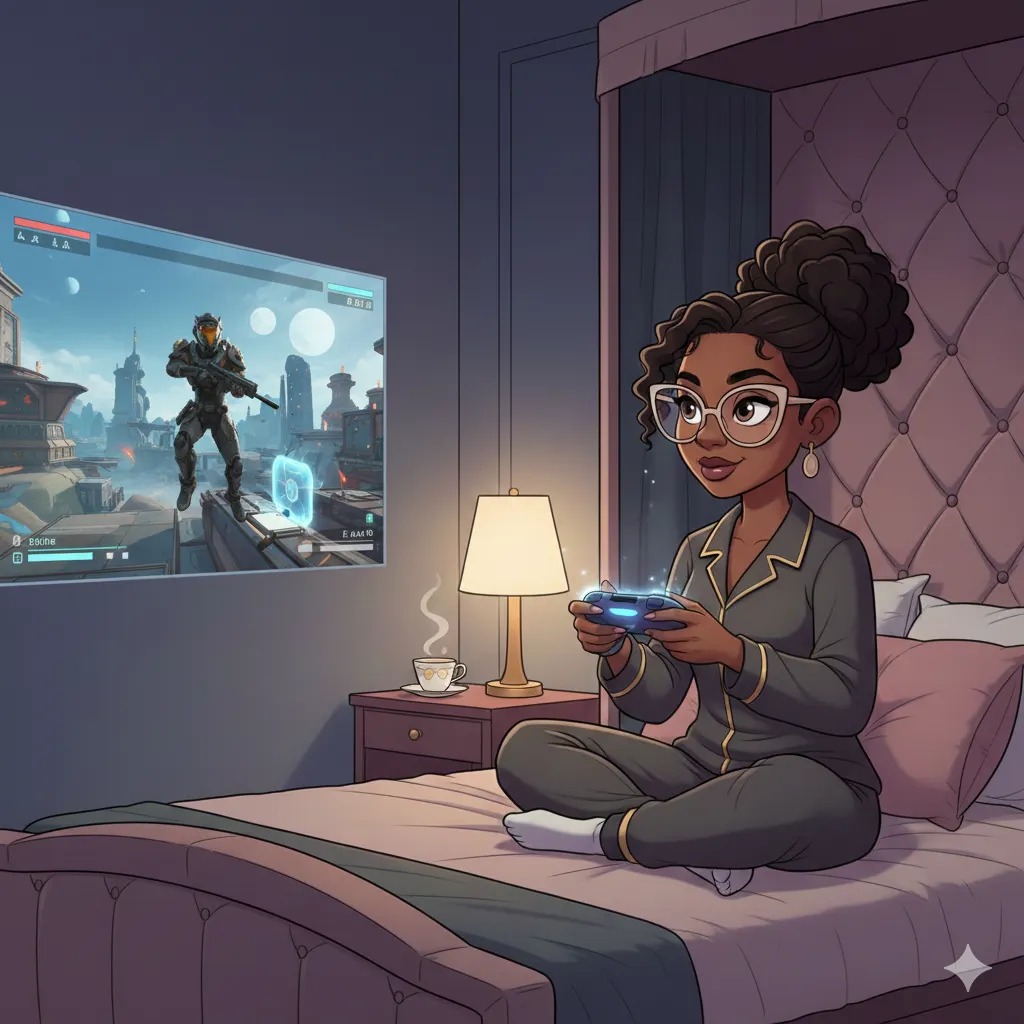
Leveling Up: How Gaming Secretly Sharpens My Strategic Brain
The Strategy Behind the Screen
When I’m not working on strategic communication frameworks or reminiscing about my days directing “Final Score Friday,” you can usually find me with a controller in my hand.
I’ve always been an amateur gamer, but I don’t just play for a high score or even placement...well, okay, I do covet my placement in certain games, but that’s beside the point. My brain is naturally wired for a specific blend of story-driven mysteries, high-speed execution, tactical positioning, and team dynamics. My gaming library is basically a breakdown of how my brain processes systems, risk, and execution in real life.
People often see gaming as a distraction, but if you look under the hood, it’s a high-fidelity training ground for spatial awareness, resource management, and situational adaptation.
Here is how the mechanics actually break down.
Tactical Radar & Map Intelligence (Apex Legends & Fortnite)
Apex is the ultimate test of squad dynamics and spatial awareness. Usually, you’re dropped in as a team of three. If you’re playing with “randoms,” you have a split second to figure out their play style and pick a character that complements them—balancing combat abilities with support or defense. If you’re rolling with a coordinated 3-stack, you already know your friends’ habits and can build a cohesive unit from the start.
Beyond the team build, Apex (& Fortnite) is all about map movement.
- Rotations & Hotspots: Knowing the high-tier loot drops vs. where half the lobby is going to land and instantly die.
- Situational Positioning: When the ring starts shrinking, do you take the high ground? Do you hold a building? If a third party rolls up on you, what’s your exit strategy?
It’s an exercise in reading the room, anticipating bottlenecks, and knowing how to navigate chaotic environments before you get cornered.
Counter-Picking & Resource Economy (Overwatch & Marvel Rivals)
Whether it’s the role-locked 5v5 of Overwatch or the more free-form 6v6 of Marvel Rivals, these games aren’t just about who can aim the fastest. They are chess matches played at 60 frames per second.
- Team Comps & Counter-Play: You have to know your character, your team’s characters, and the enemy’s roster. If the opposing team picks a character that is completely shredding your backline, you have to know who directly counters them and swap on the fly.
- Ultimate Economy & Positioning: If I burn my Ultimate ability right now to save myself, what does that leave my team with for the next objective push? If I’m playing an aggressive dive character trying to pick off their healers, can my team actually support me, or am I running on a suicide mission where I’ll just have to hunt down a health pack and pray?
It forces you to constantly ask: What are my resources, where is my team, and what is the ripple effect of this decision three steps from now?
Loadouts, Balance, and Contextual Setup (Mario Kart & Midnight Club 3)
Success in a racing game starts long before the light turns green. It’s all about setting up your loadout for the specific environment you’re about to face.
In Mario Kart, it’s the synergy between driver and kart. Do you pick a heavy character like Bowser to hold top-end speed, or do you go with an agile, lighter character like Peach or Toad to recover quickly from tight turns and drift setups? And once you’re on the track, it’s about item economy—knowing the exact right moment to deploy what you’ve collected for maximum ROI rather than just firing it off immediately.
In Midnight Club 3, street racing at 200mph comes down to reading the terrain:
- The wide, open grid of city streets in LA requires a completely different car build and handling style than the tight, unforgiving corners of Detroit.
- You constantly have to weigh risk versus reward: Is taking this alleyway shortcut actually going to pay off in the long run, or am I going to slam face-first into a dumpster and lose the lead? Do I have the right setup to beat this city’s boss?
It’s about understanding that you can’t force the exact same approach into two completely different environments and expect the same result.
Hard Resets & Repetition (Crash Bandicoot & Classic Mario)
Now, for my tried-and-true classics. My mom played Mario growing up, and I grew up on Crash Bandicoot. These precision platformers are where my patience and my temper were truly forged.
We’ve all experienced that moment: you miss a platform by a quarter-inch or miss a checkpoint and suffer a complete “crashout” because the game sends you all the way back to the start. (If you started playing games on an original NES like I did, you know this specific brand of pain).
But what that hard reset actually teaches you is pattern recognition and reps:
- You die at a specific obstacle once.
- You restart, pay attention to the timing, and anticipate the hazard.
- You repeat the sequence until the muscle memory takes over and you clear the level effortlessly.
It teaches you not to fear the hard reset. It’s just data telling you where the trap was so you can execute better on the next run.
Branching Paths & Narrative Choice
Then there are the story-driven, choice-based games. You know, the ones where picking Option A takes you down an entirely different storyline than Option B.
I love these because you are directly responsible for cultivating your own journey. You don’t just follow a pre-paved, linear rail; every dialogue choice and path fork alters the outcome. Navigating that decision tree feels a lot like running a business. You’re constantly making micro-decisions, weighing pathing options, and taking full accountability for whatever ending those choices create.
The “Gamer Logic” Takeaway
People like to separate “work” from “play,” but the mental mechanics are identical.
Whether it’s managing team cooldowns in a high-stakes match, tweaking a kart build for a specific track, or learning from a missed checkpoint in Crash Bandicoot, gaming is just applied strategy in a sandbox. It’s the constant loop of evaluating the big picture (winning the match), mastering the mechanics (the controls), and getting your reps in until execution becomes second nature.
Are you a gamer? Does your favorite hobby secretly train your brain for your day job? Drop your main or your go-to game in the comments!
#GamingAndStrategy #ApexLegends #Overwatch2 #MarvelRivals #MidnightClub3 #CrashBandicoot #StrategicThinking #WorkHardPlayHard #Fortnite
Post a comment