The Aerialist’s Pivot: How a 5-Foot Constraint Built a Better Performance
The High-Stakes Panic
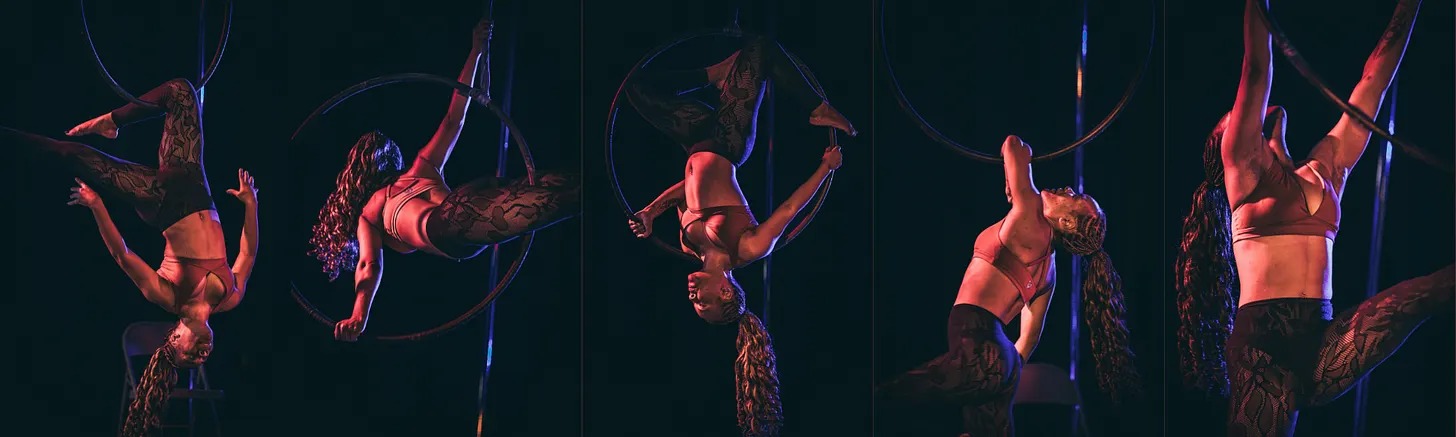
As an amateur aerialist, I practice Lyra (the suspended steel hoop you see in Cirque du Soleil) as a rigorous hobby twice a week. (I’ve been doing it for four years now. I know how to fall gracefully now.) It’s physically demanding, but the true challenge is choreography.
The winter showcase arrived, and due to a series of last-minute changes, I ended up as the only aerial performer amidst a sea of pole pieces. This meant the entire show moved to our pole studio, which had significantly lower ceilings than my practice space.
I had painstakingly crafted my final routine—after changing it 100 times, a true perfectionist’s struggle—and I was finally happy. Then, during the dress rehearsal just three days before the Saturday show, panic set in.
The Constraint: 5 Feet of Missing Capacity
Watching the performers before me, I suddenly realized the critical problem: the spanset (the rigging that attaches the hoop to the truss) was 5 feet shorter than my usual practice span.
That extra length was essential because the climax of my routine was built around me inverting on that 15-foot spanset before the final swivel, but the pole studio’s rigging was only 10 feet. With the shorter span, that high-skill, high-risk movement simply would not clear the truss above me. The core of my piece was instantly invalidated.
As my performance time approached, I had to scrap the entire ending and improvise on the fly. The rehearsal was rough, but I got through it.
The Catalyst for Greatness
The moment I stepped off the stage, I went back into choreographer mode. I didn’t waste time panicking; I used the constraint as a catalyst. In the next 48 hours, I created a semi-entirely new piece.
The end result? A dazzling new routine that I added to my arsenal, and an audience who thought the performance was amazing. Was it perfect? No, I’m a perfectionist, so it never is. But the audience didn’t see the constraint—they saw the art.
What allowed this rapid pivot was my background in news directing: expecting the unexpected and treating adaptation not as a setback, but as an operational necessity.
My Consulting Superpower: The Rapid Re-Choreography
In the corporate world, this Lyra moment happens all the time. Your “spanset” is suddenly shorter because:
- The budget (the length of the project) is cut by 25%.
- The technology (the rigging) fails the night before launch.
- A key stakeholder (the ceiling height) changes the requirements at the last minute, invalidating the core strategy (the inversion).
I help clients turn these constraints into capacity by applying a Director’s Mindset:
- Acknowledge and Isolate: Immediately identify the constraint (”The spanset is too short”) and stop focusing on the problem it caused.
- Improvise for Survival: Execute an immediate, non-perfect fix (the rehearsal improvisation) to ensure the mission isn’t stopped.
- Re-Choreograph for Excellence: Use the remaining time to create an entirely new, efficient system that works within the new constraints, often yielding a better, stronger result than the original plan.
If your team is rigid, brittle, and freezes when constraints emerge, you don’t need incremental improvement—you need rapid re-choreography. I bring the creative eye and operational discipline to turn your biggest constraints into your greatest performances.
What is the “short spanset” currently limiting your team’s success?
#Adaptability #ChangeManagement #OperationalExcellence #Consulting #JennuineRaydiance
Post a comment