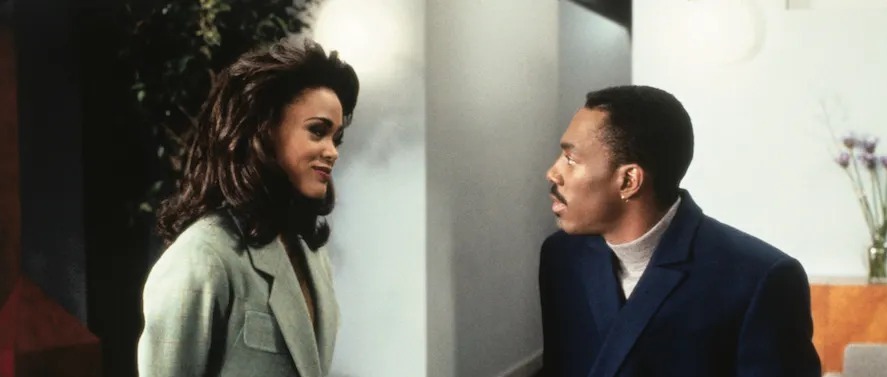
"Boomerang" & The Aesthetic vs. Function Crisis
Vibes vs. Operations: Why Your High-Fashion Aesthetic Needs a High-Fidelity Infrastructure.
Powered by RedCircle
Close your eyes and think about the ultimate Black corporate aesthetic.
Sharp shoulders. Tailored wool. Power ties. Haute couture and an office in a skyscraper overlooking Manhattan.
You're picturing Boomerang.
In 1992, Marcus Graham (and Eddie Murphy) gave us the blueprint for the Black Executive. But today, we're looking past the charm and the cologne. We're doing what I call "The Mugler Audit."
The Setup: What Marcus Actually Built
Marcus Graham is the top dog at a high-end Black advertising agency. He's got the clothes, the car, and a legendary reputation for being a closer — in the boardroom and in the bedroom. But his world starts to crumble when his agency merges with a larger firm and he meets his new boss, Jacqueline Broyer. A job he thought he was a shoe-in for.
For the first time, Marcus isn't the hunter. He's the prey.
In consulting, there's a dangerous trap called Aesthetic Overdrive. It's when a company spends so much time on the logo, the office decor, and the vibe that they forget to check if the product actually works. Marcus was a genius at branding. But his internal systems were what we experts call a mess.
The "Vibe" as a Liability
Marcus's agency, Graham-Walker, is a high-end ad shop. In the world of marketing, your image is your resume. Marcus Graham walked so the creative directors of today could run. He understood that to sell a dream, you have to look the part.
But here's the thing: your personal brand should be an elevator, not a distraction.
Marcus was so busy being Marcus Graham that he became a liability to his agency. When the merger with Lady Eloise happens, she doesn't buy the agency because of their data or their ROI — she buys it because she wants Marcus.
When your brand is built entirely on the charisma of one person, you don't have a company. You have a cult of personality. If that person catches a cold — or in Marcus's case, feelings — stock prices drop.
So ask yourself: are you building a business that can survive without your swagger, or is your aesthetic the only thing keeping the lights on?
Enter Jacqueline: The Cold Audit
Enter Jacqueline Broyer. Played by the legend and drop-dead gorgeous Robin Givens.
If Marcus is the aesthetic, Jacqueline is the audit.
She is the first person to treat Marcus like a line item instead of a legend. He tries his usual charm, his usual "I'm the top biller" energy, and Jacqueline pays him no mind. This is the imaginary camera moment for Marcus.
Jacqueline represents Market Correction. She's the reminder that no matter how good you look in a Mugler suit, the market eventually demands results. She out-Marcus-ed Marcus. More polished, more detached, and more focused on the bottom line.
When a Jacqueline enters your workspace, the old tactics won't work. You can't rely on "the way we've always done it." You have to show data. Jacqueline didn't want Marcus's charm — she wanted his performance.
If you're a founder or creative director, you have to ask yourself: if someone stripped away your cool factor, would your business still be profitable?
The Campaign: A Marketing Fail
Graham-Walker — well, Lady Eloise really — is trying to sell a fragrance. They have the models, the parties, the high-fashion aesthetic. But the campaign is struggling.
Because Marcus was trying to market romance while feeling like he was living inside a hostile takeover.
Those of you who work in marketing know exactly what I'm talking about. A client comes to you and says, "We need a new marketing campaign." But after ten minutes of conversation, you realize they don't need marketing — they need a Mission Statement. They don't know who they are or who they're talking to, so they're just throwing expensive vibes at the wall and following popular trends, hoping something sticks.
Marcus failed because he lost his Why. He was so focused on the How — how the office looked, how the suits fit, how the girls smiled — that he forgot the Who. Who are we serving?
Marcus became his own audience. And that's the most expensive mistake a brand can make.
The Angela Factor: The Pivot to Authenticity
Then there's Angela. Halle Berry. Angela is the Internal Hire that everyone overlooked because she wasn't wearing the Mugler armor. She was the one actually doing the work.
In every office, there's an Angela. She's the one who actually understands the product. In business terms, Angela is the User Experience. While Marcus was focused on the User Interface — the pretty buttons and the shiny packaging — Angela was focused on the feeling. How it actually lands with real people.
The campaign only succeeds when Marcus stops trying to be Marcus Graham and starts being a partner to Angela. This is the Strategic Pivot. It's the moment a business realizes that Cool doesn't scale — but Connection does.
The Suit Takeaway
Aesthetics are a tool, not a strategy. You can wear the $3,000 suit. You can have the sleekest website in your industry. You can have a vibe that stops traffic. But if your internal systems are hollow, the market will eventually find you out.
Don't let your personal brand become a distraction from your professional purpose. Be as confident and charming as Marcus — but be just as smart and cunning as Jacqueline, with the heart of an Angela.
Before you go, here's your homework. Look at your brand this week. Are you hiding behind a Mugler suit? Is your business all vibe and no value? If so, it might be time for an audit.
Post a comment